Features
Where your demo really goes after you hit send
You made something private and sent it to one person you trust. From that moment it's out of your hands. Here's the journey your track actually takes, and why sharing music and sending a file are two very different things.
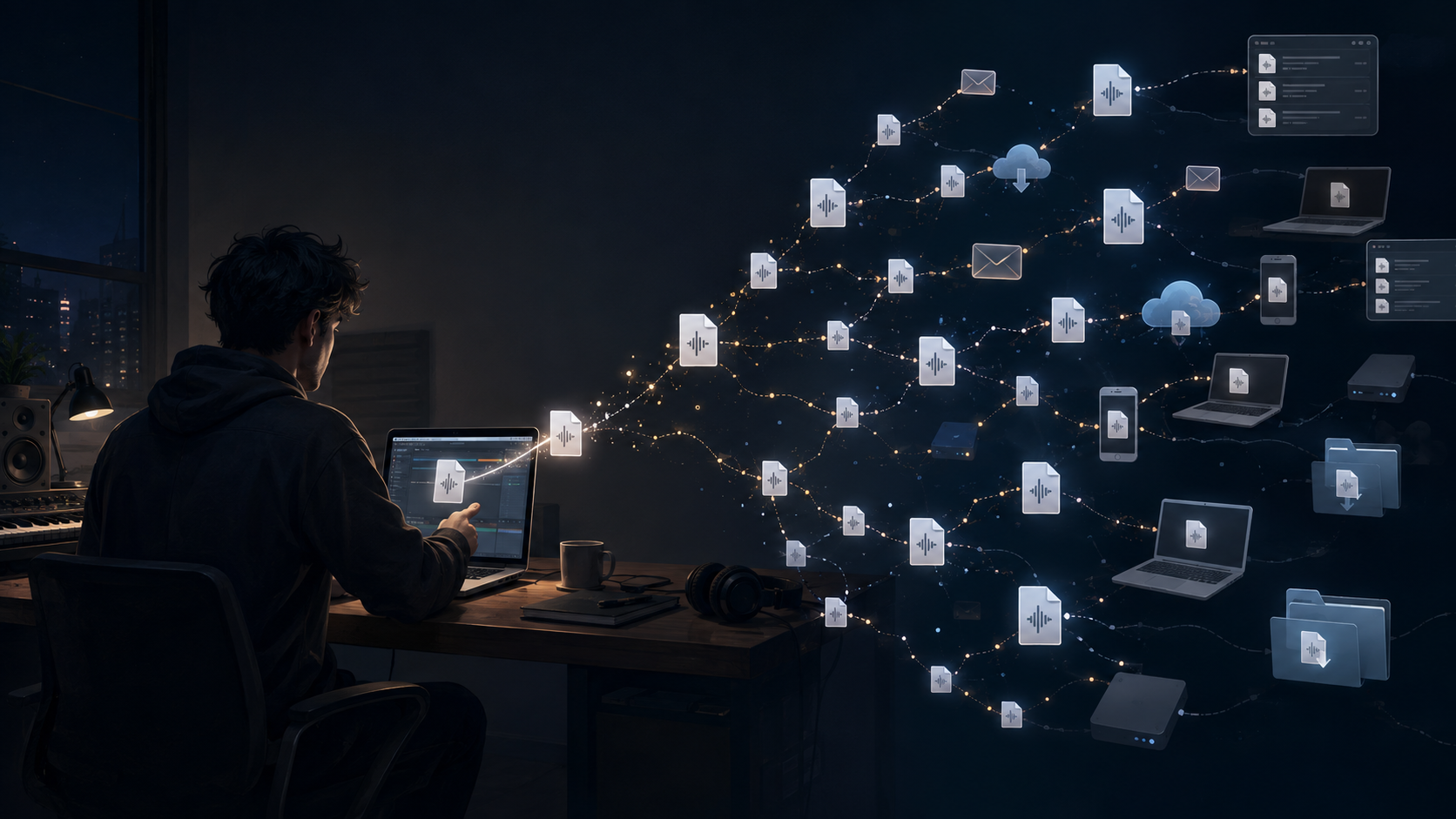
You finish a rough mix at 2am. It isn't done (the vocal's a scratch, the low end's wrong), but it's good enough to show one person. So you attach it to an email, or drop it into WeTransfer, and hit send.
It feels like a private handoff. One track, one person, one time.
It isn't. The second that file leaves your machine, you've stopped sharing your music and started giving away copies of it, and you can't get them back.
A file is a copy, not a loan
This is the part that's easy to forget. When you lend someone a guitar, they give it back. When you send someone an MP3, they keep a perfect, permanent, identical copy, and so does everyone they forward it to. There's no "return." There's no "expired." There's just another copy, out in the world, doing whatever the person holding it decides.
You didn't share a song. You manufactured and distributed it, one recipient at a time.
The afterlife of an attachment
Follow a single unreleased track after you send it and the trail gets long fast:
- It's downloaded to a laptop, into a Downloads folder that never gets cleaned out.
- It's auto-synced to someone's cloud backup, so now it lives on servers you've never heard of.
- It's forwarded to "one other person who needs to hear this," who forwards it again.
- It's sitting in an email thread with five people CC'd, searchable forever.
- Months later it's a mystery file on a hard drive, with no idea who made it or whether it was ever meant to be out.
None of that requires anyone to act in bad faith. This is just what files do. Copying is the one thing computers are truly great at.
The damage isn't always a "leak"
When we picture unreleased music getting out, we imagine a dramatic leak. Those happen, but they're rare, and they're not the everyday problem.
The everyday problem is quieter. A rough mix gets played to someone important before it's ready, and their first impression of the song is the worst version of it. A scratch vocal gets mistaken for the final. A title or a lyric idea travels further than you meant it to. A track you were still shopping turns up somewhere that makes the next conversation awkward.
You rarely lose control of your music in one dramatic moment. You lose it one forwarded attachment at a time.
Sharing without sending
The fix isn't paranoia, and it isn't watermarking every bounce or making people sign an NDA to hear a chorus. It's changing the unit you share.
Instead of sending a copy, share access to a page you control. The music streams; it doesn't land in a Downloads folder. You can see who actually listened. You can swap the mix without re-sending anything. And when the conversation's over, you can switch the link off, which is something you can never do with a file that's already gone.
That's the whole idea behind Songbox, and honestly it's why we built it the way we did: a link, not an attachment. You decide who gets in, what they can do, and for how long. The song stays yours the entire time.
You can't unsend a download. The trick is to never have to send one in the first place.